Every single day, millions of new articles are published across the web, yet only a tiny fraction ever reach the first page of Google. The difference between a high-ranking post and an invisible one often boils down to two structural metrics: word count and readability. If your content is too brief, search engines might categorize it as unhelpful or thin. If your content is too complex or dense, human readers will immediately leave your site, severely damaging your user engagement signals.
In this guide, you will learn exactly how search algorithms evaluate content depth and topic coverage. You will discover why reading levels directly dictate user engagement and bounce rates. Finally, you will learn how to consistently optimize your writing to rank higher, satisfy search intent, and keep readers glued to the page.
The Real Relationship Between Word Count and SEO
There is a persistent myth in the SEO industry that simply writing more words automatically leads to higher search rankings. This is a severe misunderstanding of how search algorithms actually operate today. Search engines do not reward word count for the sake of volume.
Instead, search engines reward comprehensive topical coverage. When you write a longer article, you naturally include more related keywords, secondary entities, and semantic variations of your core topic. This gives algorithms like Google’s BERT more contextual clues to understand exactly what your page is about.
Long-form content naturally attracts more backlinks because it serves as an authoritative resource. When an article covers a topic from every possible angle, other webmasters are far more likely to cite it as a definitive guide. However, adding hundreds of irrelevant filler words will actively harm your rankings by diluting your core topic.
Topical Authority and Semantic SEO
Search engines use natural language processing (NLP) to read and categorize your content. They look for specific “entities” or concepts that typically appear together. If you write an article about “making coffee,” the algorithm expects to see related terms like “beans,” “grind size,” “water temperature,” and “French press.”
A 300-word article simply does not have the physical space to include all of these necessary semantic signals. A 1,500-word article, on the other hand, provides ample room to explore each of these subtopics in detail. This signals to the search engine that you are an authority on the subject, making you highly relevant for a wider variety of long-tail search queries.
Word count acts as a byproduct of high-quality, comprehensive writing. You should never write to hit an arbitrary number. You should write until you have completely and thoroughly answered every question a user might have about that specific topic.
Search Intent Dictates Ideal Length
Not every search query requires a 2,000-word manifesto. The ideal length of your content is entirely dictated by what the user is actually trying to accomplish. This is known as search intent.
If a user searches for “what time is the Super Bowl,” they want a single sentence with a clear time and date. Giving them a 3,000-word history of American football will result in an immediate bounce. Conversely, if a user searches for “how to build a custom computer,” they expect a massive, detailed, step-by-step guide with diagrams and troubleshooting tips.
| Search Intent Type | User Goal | Ideal Content Format | Target Depth |
|---|---|---|---|
| Informational | Learning about a broad or complex topic. | Comprehensive guides, tutorials, and deep-dive articles. | High (1,200 – 3,000+ words). Focus on thorough explanations. |
| Transactional | Completing a purchase or signing up. | Product pages, pricing tables, and strong calls to action. | Low to Medium (300 – 600 words). Focus on conversions and benefits. |
| Navigational | Finding a specific website or login page. | Clean, minimal landing pages with clear buttons. | Very Low (under 300 words). Focus on immediate routing. |
| Commercial | Comparing options before buying. | List articles, reviews, and comparison tables. | Medium to High (800 – 2,000 words). Focus on objective analysis. |
Why Readability is a Secret Ranking Factor
You can write the most comprehensive, scientifically accurate article in the world, but if it reads like a dense academic textbook, it will fail online. Readability is the measure of how easily a typical user can understand your written text. It directly impacts your SEO performance through user experience signals.
Google measures how users interact with your website after clicking a search result. If a user clicks your link, feels overwhelmed by a giant wall of complex text, and immediately hits the back button, they trigger a “pogo-sticking” event. This tells Google that your page was a poor result for that query, and your rankings will slowly drop as a result.
The Science of Cognitive Load
Reading on a screen is physically harder on the eyes than reading printed paper. Users do not read web pages word-for-word; they scan them in an F-shaped pattern looking for specific information. High readability reduces the cognitive load required to process your information.
When you use simple language, short sentences, and plenty of visual breaks, you allow the user’s brain to quickly parse the value of your content. This increases “dwell time,” which is the amount of time a user spends on your page before returning to the search results. High dwell time is a massive indicator of quality to search engines.
Key Elements of High-Readability Content
Optimizing for readability is not about dumbing down your content. It is about removing friction from the reading experience so your expertise can shine through.
Here are the critical components you must optimize to keep readers engaged:
- Short Sentences: Aim for an average of 15 to 20 words per sentence. Anything longer forces the reader to hold too much information in their short-term memory.
- Active Voice: Write “The dog bit the man” instead of “The man was bitten by the dog.” Active voice is punchy, direct, and easier to visualize.
- Plain English: Avoid industry jargon whenever possible. If you must use a technical term, define it clearly in the very next sentence.
- Visual Hierarchy: Use H2 and H3 headings to break up large sections. This allows scanners to find exactly what they care about instantly.
- Transitional Phrasing: Use simple bridging words to pull the reader from one paragraph to the next, creating a smooth, slippery slope of text.
The Anatomy of High-Ranking Content
Writing content that perfectly balances deep topical authority with simple readability requires a systematic approach. You cannot simply sit down and start typing blindly if you want to compete in competitive search results. You need a structured workflow.
By following a standardized drafting process, you ensure that every piece of content you publish meets high quality standards before it goes live. This prevents you from wasting time on massive revisions later.
Here is the exact step-by-step process for generating highly optimized, readable content:
- Analyze the SERP Intent: Type your target keyword into Google and open the top three results. Look at their headings, their total word counts, and the specific questions they answer to establish your baseline requirements.
- Outline for Comprehensive Depth: Create a skeleton of H2 and H3 tags that covers every angle found in the top competitors, plus one or two unique angles they completely missed.
- Draft Without Editing: Write the content quickly to get your ideas on the page. Focus entirely on explaining the technical concepts accurately, without worrying about sentence length or grammar just yet.
- Run Readability Diagnostics: Push your text through a reading level calculator. Look for passive voice, sentences over 25 words, and paragraphs longer than three sentences.
- Trim and Format: Ruthlessly cut adverbs and unnecessary filler words. Break long paragraphs in half. Add bullet points and bold text to highlight key takeaways for fast scanners.
Practical Application: Automating Your Content Optimization
Manually counting words, checking sentence lengths, and ensuring consistent formatting is a massive waste of your valuable time. This is exactly where our suite of utility tools becomes an essential part of your publishing workflow. By automating the mechanical aspects of content editing, you can focus your energy entirely on strategy and research.
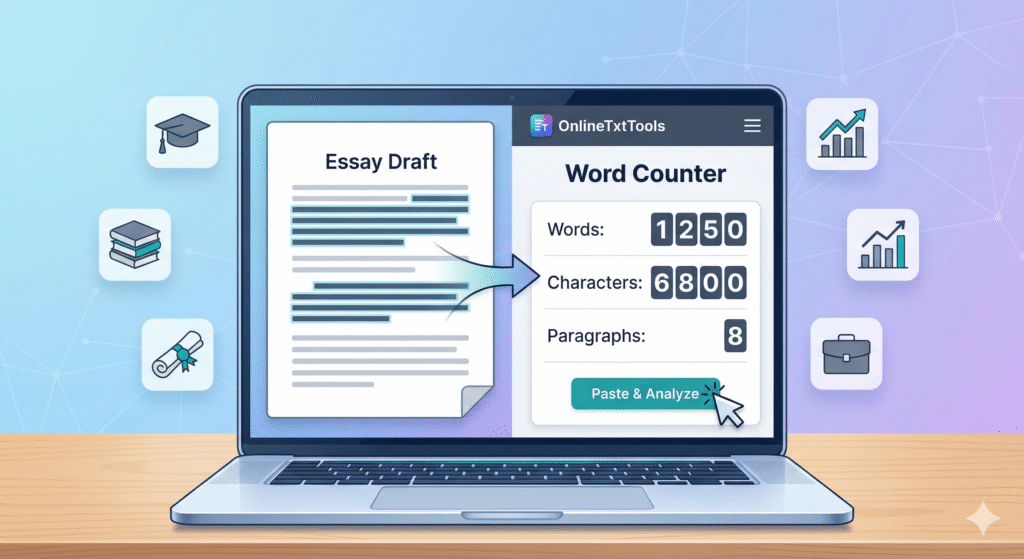
Before you publish any article, paste your draft into our Word Counter. This tool will instantly verify if you have hit the target depth required to compete with the top search results. It also breaks down your character count and paragraph count, ensuring you have enough structural spacing to maintain high readability.
Formatting your headings correctly is another crucial step for visual readability. Using our Case Converter, you can instantly transform messy, inconsistent headers into perfect Title Case or Sentence Case with a single click. This guarantees your visual hierarchy looks professional and polished, which builds immediate trust with your readers.
Even backend security plays an indirect role in SEO, as search engines favor secure, trusted sites. While you optimize your text, you can secure your publishing platform or CMS by generating impenetrable credentials using our Password Generator. Using these integrated tools ensures every aspect of your website, from the frontend text to the backend access, is fully optimized and secure.
Frequently Asked Questions
What is the ideal Flesch-Kincaid reading score for SEO?
For most general web content, you should aim for a Flesch Reading Ease score between 60 and 70. This translates roughly to an 8th or 9th-grade reading level. At this level, your content is easily understood by the vast majority of the adult population without feeling overly simplistic. If you are writing for a highly technical B2B audience, a score of 50 is acceptable, but you should still strive for clarity.
Will Google penalize me if my article is under 500 words?
Google does not have a strict minimum word count penalty. If you can completely satisfy a user’s search query in 300 words, Google will happily rank that page. However, for highly competitive, informational keywords, a 500-word article usually lacks the semantic depth and secondary keywords required to outrank a well-written 2,000-word guide.
Does keyword density still matter for search rankings?
Strict keyword density percentages are a severely outdated SEO metric. Packing your target keyword into every paragraph will trigger spam filters and ruin your readability. Instead, focus on keyword prominence (placing the term in the title, URL, and first paragraph) and semantic relevance (using natural synonyms and related industry terms).
Conclusion
Mastering SEO writing requires a delicate balance between machine algorithms and human psychology. Word counts ensure you provide the topical depth search engines need to understand your authority, while high readability ensures human users actually stay on your page to consume that information. By leveraging automated utility tools to streamline your editing process, you can consistently produce comprehensive, clear, and highly competitive content that ranks well and converts readers.